
Quick answer: how should you read the Evomon map?
The Evomon map is most useful as a route and readiness check, not as a promise that every location, level, or spawn table will stay fixed. Start with Maincity as the hub, follow the broad island order toward newer areas, and use each region's level band to decide whether you should explore, train, or return later. The map question is different from a beginner checklist: it tells you where a zone fits in the world and what to verify before you travel.
Public references currently describe a mostly linear journey through areas such as Verdant Valley, Petal Pond, Lava Crag, Amber Acres, Autumn Hill, Shiver Snows, Flying Territory, Raven Ridge, Silent Sands, Crystal Cascade, and later regions. Names, boss levels, and optional areas can change after a Roblox update, so treat the directory below as a readable planning index. Open the live experience when an objective, teleport label, or encounter differs.
This page also separates map scope from nearby guides. Use the beginner guide for a first-session sequence, the boss guide for battle preparation, the Dex for creature entries, and the Bluebird guide for one creature's location. Keeping those tasks separate makes the Evomon map easier to scan and reduces the chance of following an old list for the wrong purpose.
Use the region order to choose your next check, then use the live map, objective text, and encounter screen to confirm the exact route. A community map is a lead; the current game is the final state.
Evomon map route overview: move in checks, not guesses
A good route overview answers three questions before you spend time traveling: where you are starting, what the next region is meant to test, and which signal tells you that it is time to move on. The public map pages we reviewed all use an island or region index because players search for order first. Use the same order here, but keep the numbers flexible when a source does not expose a current in-game requirement.
The five-step loop below works for a new route and for a return visit after an update. It also prevents a common map mistake: treating a boss list, a creature list, and a teleport list as if they were the same thing. Record the label you actually saw, the level range shown by your server, and the reason you are visiting.
- 1
Begin at Maincity
Use Maincity as the reset point for travel, shops, quest turns, and party changes when the current interface provides those options. Check the live teleport labels before assuming every destination is unlocked.
- 2
Confirm the next island
Compare the route order with the objective or access prompt in your server. Verdant Valley and Petal Pond are commonly described as early stops, but a new player should still read the current unlock message.
- 3
Read the level band
Use a listed level range as a preparation signal, not an automatic victory guarantee. Check the wild encounter, boss preview, and your party's weakest role before farming a full level.
- 4
Mark optional areas
Summon Ruins and other side regions may serve a different purpose from the main island route. Note whether the map calls them optional, challenge, summon, or event content before changing your main objective.
- 5
Log the result
Write down the region label, the route change, the encounter or boss you saw, and the date. A short note is more useful than reposting an undated map when the next patch changes a name or reward.

Evomon islands map checklist: what to record in each region
A map directory is more useful when every zone has the same small set of notes. Record the route position, the level signal, the main reason to visit, and the verification point. The names below reflect the regions surfaced by the current public map references; they are a planning vocabulary, not a permanent official database.
Early route: Verdant Valley and Petal Pond
Treat these as learning and coverage checks. Verdant Valley is commonly presented as the first island route, while Petal Pond is described as an early follow-up with its own water pressure and daily or repeatable activity clues. Confirm the actual objective and enemy levels before committing rare resources.
- Check the first boss or route gate
- Add one different type before overtraining the lead
- Record the next teleport label and level hint
Middle route: Lava Crag, Amber Acres, and Autumn Hill
The middle regions are where a team can feel strong in one matchup and suddenly narrow in another. Use the map to plan the next coverage slot, then test ordinary encounters before spending an evolution stone, reroll, or expensive equipment upgrade. A region name alone does not prove a fixed spawn table.
- Compare fire, ground, and other pressure signals
- Keep a reserve member for an unfamiliar matchup
- Separate wild encounters from boss-only records
Later route: Shiver Snows, Flying Territory, and Raven Ridge
Later route names often appear in creature and boss searches because players want a location quickly. Use the map page to identify the region first, then open the Dex or the specific creature guide for a narrower check. If a community entry gives a precise tile or rate, verify it in the current server before farming.
- Read the access requirement before traveling
- Check whether a location is a route, dungeon, or event
- Capture the date and server state with your note

Hubs, Summon Ruins, and side areas on the Evomon map
Not every place on an Evomon map serves the same job. A hub helps you reset and prepare, a main island advances the route, and a ruin or side area may ask for a summon, event item, or separate challenge. The table keeps those roles distinct so you do not bring a farming plan to a one-time objective.
| Map signal | What to do | Avoid |
|---|---|---|
| Maincity or hub | Use it to change the party, review supplies, read objectives, and confirm the next teleport when available. | Treating the hub as a wild spawn zone or assuming every island is unlocked. |
| Main island | Follow the route order, scout ordinary encounters, and record the level band before a boss attempt. | Using a boss level from an old guide as a guaranteed minimum. |
| Summon Ruins | Check whether the current prompt asks for a summon, key, event condition, or separate entry point. | Farming the main island while expecting a ruin-only reward. |
| Named location | Match the name in the objective, map, and creature or boss screen before sharing a location claim. | Merging similar names or copying a community coordinate without a date. |
Public map pages disagree on counts and labels for optional regions. Use this role-based table to plan a check, then trust the current Roblox interface for the exact access rule.
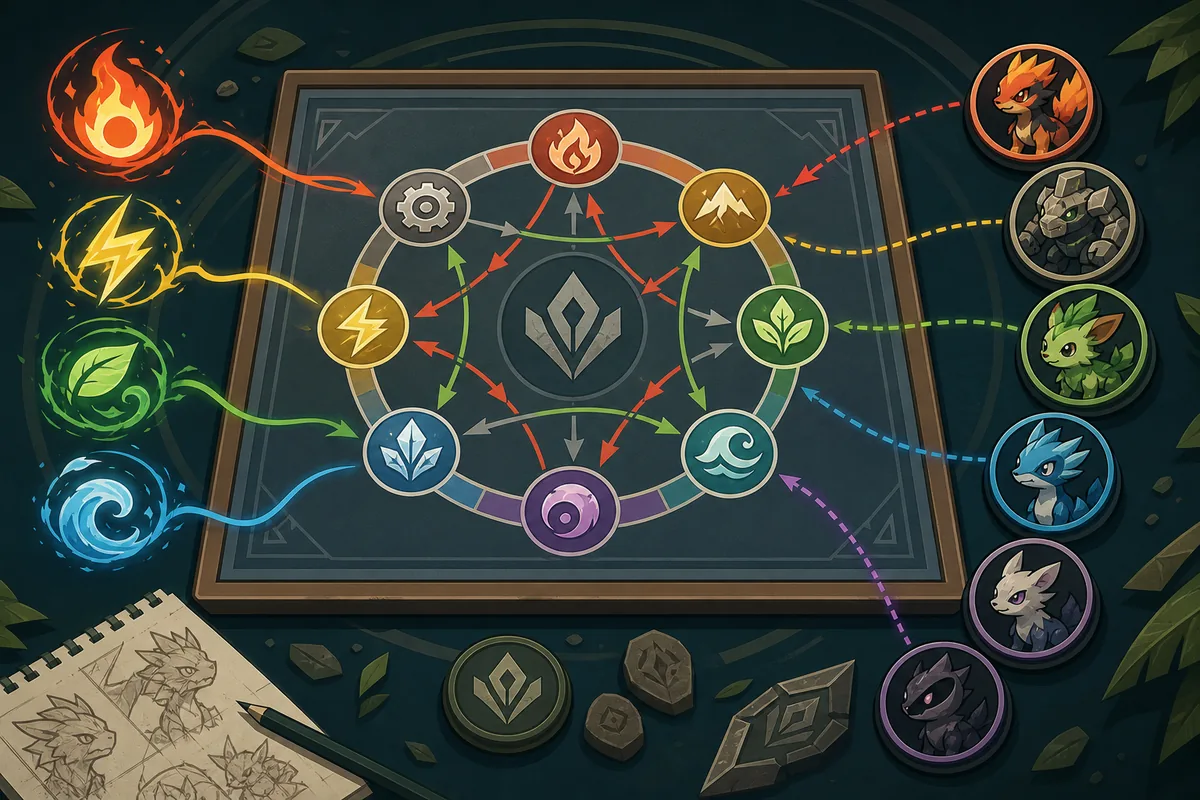
Match an Evomon map route to your team and resources
The strongest map guide does more than list islands. It helps you decide whether to push forward, pause for a catch, or return to a hub. Before entering a new region, compare the next pressure with your team's types, speed, durability, and move coverage. A route that looks easy on paper can still expose a shared weakness, while a lower-level area can be the efficient place to confirm an evolution or gather a common resource.
Use the map as a planning boundary and the separate guides as deep references. The type chart answers matchup questions, the team-building page helps distribute roles, the equipment page covers upgrades, and the evolution-stones page covers scarce materials. This keeps your map notes short and prevents a location article from pretending to be a full tier list or drop table.
1. Choose the next problem
Decide whether the next region is for story access, a boss, a creature, a material, or an optional challenge. One clear purpose tells you what to measure and which guide to open next.
2. Prepare a flexible answer
Keep a lead, a switch, and a reserve that cover different pressures. Test the plan in ordinary fights so you do not discover a shared weakness after spending a rare item.
3. Spend after the route check
Use common supplies to scout first. Delay expensive equipment, rerolls, and evolution materials until the live objective confirms the region and the investment solves a real bottleneck.
How to verify an Evomon map after an update
A map page can age quickly when a Roblox update changes labels, teleports, bosses, or encounter pools. Verification does not require a full research project every time. It requires a repeatable check that distinguishes a changed route from a missing player objective.
- Compare the live labelRead the zone name in the teleport, objective, or screen header. If it differs from the guide, save the exact wording instead of silently normalizing it.
- Check the access stateLook for the current level, quest, boss, item, or event condition. A locked destination and a missing spawn are different problems.
- Scout one ordinary encounterRecord the visible level range, type pressure, and whether the creature or resource appears in the place you expected. Do not infer a full table from one run.
- Test the objectiveIf a boss, quest, or summon is the reason for travel, confirm that the current action advances the named objective. A similar fight may not count.
- Update your noteKeep the date, region label, server context, and source link. Mark uncertain details as reported rather than publishing a fixed claim that the next patch can invalidate.
Common Evomon map mistakes
Confusing map order with boss order
A boss guide may list encounters and reported levels, while a map guide explains where a region sits. Use both pages for their separate jobs.
Treating a level range as a hard requirement
A recommended band is a readiness signal. Your moves, equipment, type coverage, and the current balance patch still affect the result.
Assuming every named area is a normal island
Hubs, ruins, dungeons, event areas, and side challenges can appear in the same directory. Read the access prompt before planning a farming loop.
Copying a precise location without a date
A community coordinate, spawn, or reward may be old. Keep the source and check date with your own server evidence before sharing it as current.
Evomon map FAQ
Is there an official Evomon map?
Public sources show route images and map labels, but they do not establish a single permanent official atlas with every coordinate. Use the live Roblox experience for current names, access states, and objectives, and treat fan maps as planning references.
What is the first area on the Evomon map?
Maincity is commonly described as the hub, with Verdant Valley presented as an early island route. Confirm the first destination and any level or quest gate in your current server because labels can change.
What order should I visit Evomon islands?
Follow the broad route from Maincity through the early, middle, and later regions shown by the current teleport or objective menu. A community directory can suggest order, but the live unlock message decides which island is next for your account.
Where are Summon Ruins on the Evomon map?
Summon Ruins are listed as optional or challenge areas in public map references. Look for the current ruin label and read its summon, key, event, or access requirement instead of assuming it follows the main island route.
Can I use the Evomon map to find a specific creature?
Use the map to identify the likely region, then open the Dex or a focused creature guide and verify the encounter in the live server. A region name alone does not prove a current spawn rate or exact tile.
What level should I be for the next Evomon island?
Use the published level band as a rough preparation signal, then compare your party's weakest matchup, moves, equipment, and the current encounter or boss preview. Do not treat an old number as a guaranteed requirement.
Is this an official Evomon map guide?
No. Evomon.blog is an independent fan guide. It separates public community observations from first-party checks and points players to the official Roblox experience when the map, objective, or interface changes.
Sources and verification notes
- Official Roblox Evomon experience - Use the live experience for current map labels, access prompts, objectives, and encounter screens.
- Eurogamer: All regions in Evomon - A dated third-party region directory checked for common area names and content shape; it is not treated as a permanent official table.
- Evomon community map reference - Community map structure checked for island, level, boss, and route concepts; verify patch-sensitive details in game.
- Evomon Wiki source policy - Explains the independent fan-guide scope and verification approach.